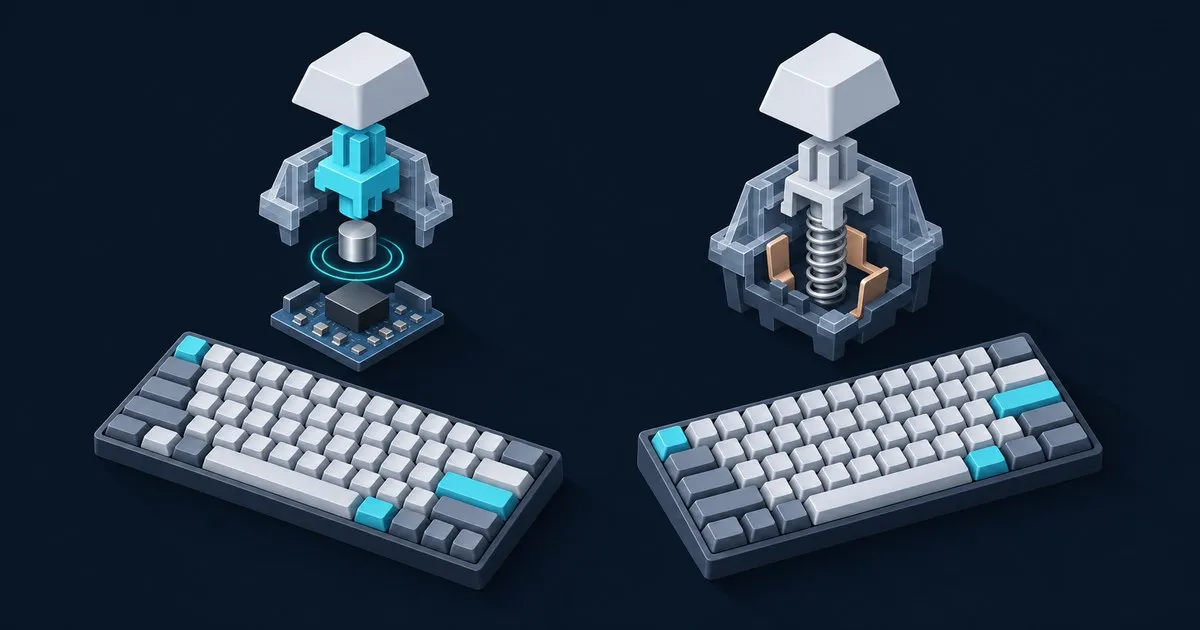
switches
Hall Effect vs Mechanical Keyboard: Which Is Better?
Hall effect wins for competitive FPS with rapid trigger; mechanical wins for typing feel, switch variety, and…

Gateron Yellow vs Cherry MX Red compared on force, travel, factory lube, sound and price, with a pick for typing, gaming and hot-swap builds.
Read the article →Hall effect wins for competitive FPS with rapid trigger; mechanical wins for typing feel, switch variety, and…

Compare Mac wireless mechanical keyboards by documented connectivity, hot-swap variants, construction and pol…

Compare four 60% keyboards by input type: Wooting 60HE v2 magnetic, HyperX Alloy Origins 60, Bluetooth Anne P…

Compare four mechanical keyboards under $100 for gaming, wireless use, compact desks, and first-time buyers, …

Compare ANSI, ISO and JIS keyboard layouts by Enter key shape, modifier sizes, keycap compatibility and input…

Troubleshoot common mechanical keyboard problems, including chattering keys, dead keys, rattly stabilizers, U…
The decisions that come before a shortlist: which size and layout standard fit your work, which features matter, and what to do when a board misbehaves.
Full-size to 40%, Alice and split: key counts, published widths, and layout choices.
Keys, dimensions, layers and keycap fit for both compact sizes in one guide.
The three physical standards, and how the choice narrows your keycap options.
What moves to a layer, and which input features distinguish four compact boards.
Chattering keys, dead keys, rattle and connection drops, diagnosed in order.
The criteria that decide whether a board holds up over an eight-hour coding day.
Six questions, then a scored top three with a budget alternative and a step-up pick.
Three documented 75% boards compared by connection modes and Mac keycap support.
Keyboard Ranker publishes focused, sourced guides on a single topic. No paywall, no account, no ad tracking.